
Container Gardens
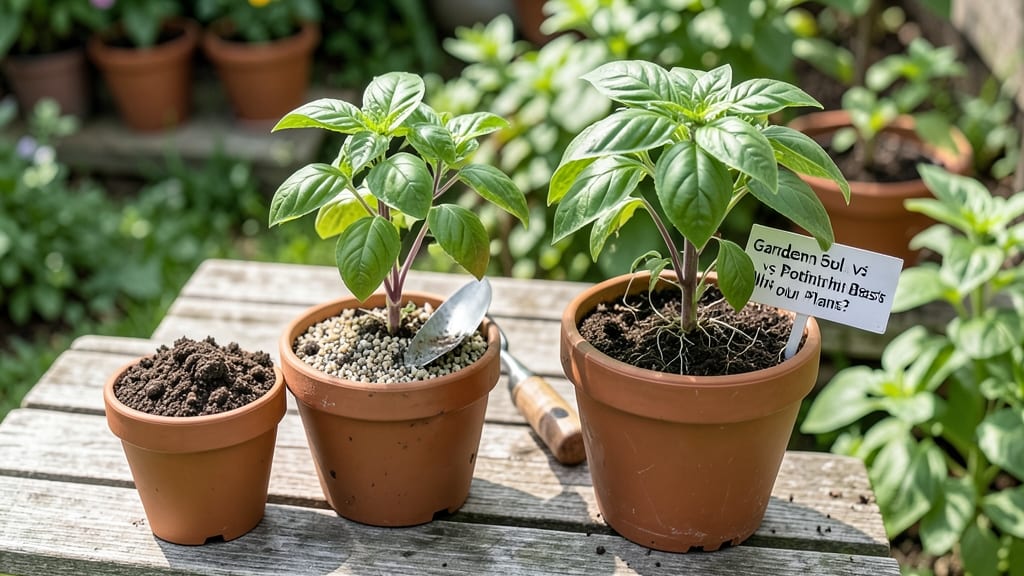
You shouldn't use garden soil in pots because it compacts easily, drains poorly, and promotes harmful fungal growth. Instead, choose a lightweight potting mix with perlite, vermiculite, or compost to keep roots healthy and prevent waterlogging.
Garden soil is designed for in-ground planting, where roots can spread freely and excess moisture evaporates naturally.
In containers, though, the confined space causes soil to become dense and waterlogged, suffocating roots and inviting pests. 🌱 I've seen firsthand how plants in garden soil pots wilt faster and recover slower—even with regular watering.
The key difference is aeration: potting mixes are specifically formulated to stay loose, allowing oxygen to reach roots while still retaining enough moisture.
For best results, mix 50% peat or coco coir with 30% perlite or vermiculite and 20% compost. This combination prevents compaction while providing essential nutrients. Herbs and vegetables thrive in this blend, while succulents need even more gritty additives like coarse sand or pumice.
💡 In This Article
- Why Garden Soil Fails in Container Gardens
- Best Potting Mixes for Healthy Container Plants
Why garden soil fails in container gardens
Garden soil is engineered for in-ground planting where roots can spread horizontally and vertically without restriction. In pots, though, the confined space causes soil particles to pack tightly together, reducing pore space by up to 70% compared to ideal potting mixes.
This compaction creates a dense matrix that blocks oxygen from reaching roots, leading to suffocation and stunted growth. 🌱 The problem worsens over time as organic matter decomposes, leaving behind a compacted, nutrient-poor medium that resembles concrete more than soil.
Drainage is another critical failure point. Garden soil often contains high clay content (10-30% in many regions), which absorbs water like a sponge but releases it slowly—far too slowly for container plants.
When you water potted plants, excess moisture has nowhere to escape, creating waterlogged conditions that trigger root rot within 2-3 days. Compare this to potting mixes with 40-60% perlite or vermiculite, which allow water to drain freely while still retaining moisture for roots.
The dense environment also creates perfect conditions for harmful pathogens. Fungal diseases like Phytophthora and bacterial infections thrive in waterlogged, compacted soil because they feed on decaying organic matter trapped in the dense matrix.
I've seen basil and tomato plants in garden soil pots develop black spots within 10-14 days—a clear sign of fungal infection. The lack of airflow in garden soil accelerates this process, while potting mixes with proper aeration keep roots healthier for longer.
Nutrient imbalance is another hidden issue. Garden soil contains a broad spectrum of nutrients, but they're often locked in forms that plants can't access quickly. In containers, where plants grow faster due to controlled environments, this slow release becomes a problem.
Potting mixes, on the other hand, use fast-acting compost or worm castings that provide immediate nutrients while still supporting long-term microbial activity. 💫 This balance is crucial for container plants that need consistent feeding every 2-4 weeks.
Consider the texture difference: garden soil feels heavy and clumps together when damp, while quality potting mixes remain light and crumbly. This structural difference is what allows roots to penetrate easily and access both water and oxygen.
The ideal potting mix should feel like a dry sponge—light enough to hold in your hand but firm enough to maintain structure when watered.
For example, try this test: Take a handful of garden soil and potting mix, saturate them with water, then squeeze. Garden soil will form a dense, waterlogged clump that takes minutes to drain, while potting mix will release water almost immediately.
This simple test demonstrates why garden soil fails in containers where drainage is everything. 🔥